Non-Transitivity in the National Hockey League:
Ranking Teams, Lines, and Players
using Game Theory
David Radke and Troy Mulholland
Proceedings: LINHAC 2026
[Click for Paper]
Abstract:
The game theoretical complexity of ice hockey creates a large
strategy space for teams to exploit. This suggests teams can counteract
any opponent strategy; however, the clear distributions in team strength
place emphasis on roster construction and collective performance. We
analyze the game theoretical landscape of the National Hockey League
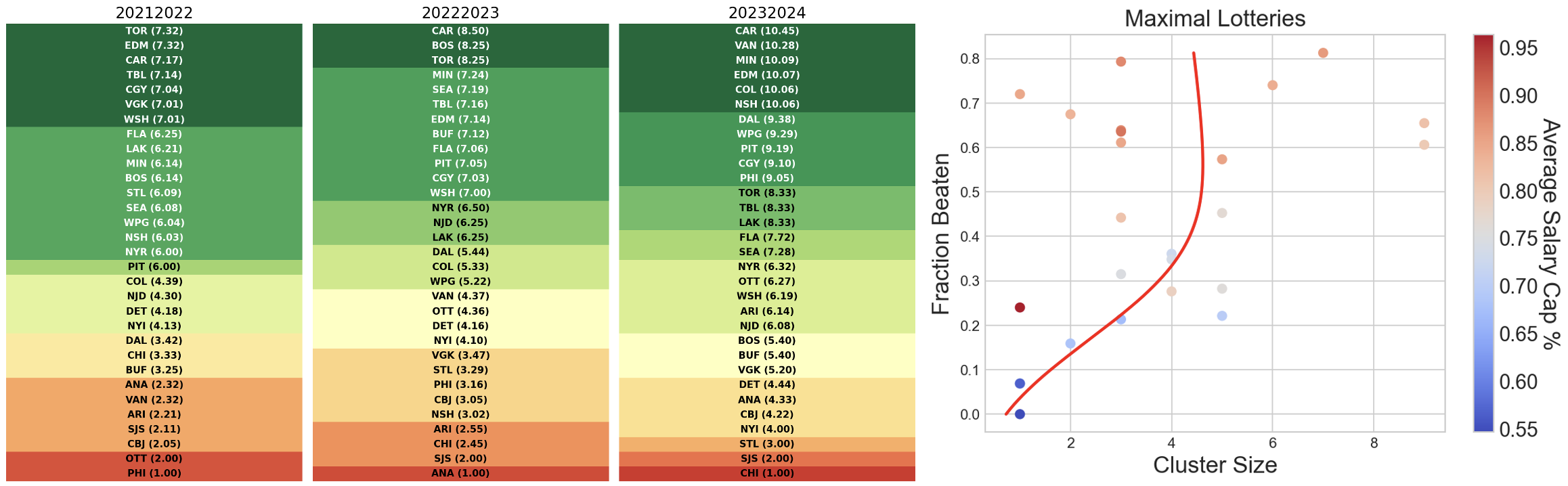
(NHL) by modeling the transitive and non-transitive interactions between teams based on possession value of events. We utilize recent methods from artificial intelligence (AI) to rank teams, forward lines, and
individual players in the NHL over three seasons. Our rankings satisfy a
core social choice axiom that Elo and Bradley-Terry rankings violate in
6.8% and 3.7% of rankings respectively due to extensive non-transitivity.